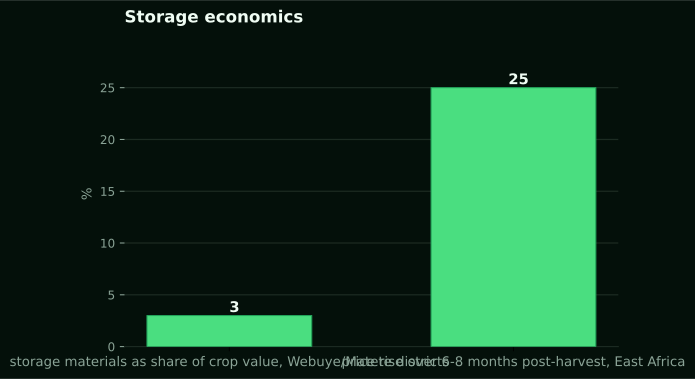
Maize prices in East Africa can rise by 25 to 40 percent over the six to eight months after harvest, according to the Innovative Finance and Grain Storage among Farmers study from CEGA Berkeley. That is the whole case for storing maize in Kenya rather than selling it at the gate in July. The trouble is that storage is not free. It is not risk-free either. The two costs that matter, the cash cost of the bag or silo and the physical loss inside it, rarely get set against each other in the same sentence.
The sale you make in a hurry, and what it actually costs
Selling immediately at harvest looks like the cheapest option because there is no storage bill. It is not cheap. It is a forfeited price rise of 25 to 40 percent, the figure from the same CEGA Berkeley collection above, measured across East Africa rather than a single Kenyan county. On a 585 kg harvest, the median quantity recorded among Rift Valley and Lower Eastern farmers in a cross-sectional study of postharvest maize storage practices published on PMC, a 30 percent price rise is a meaningful sum lost to nothing more than timing.
The reason farmers sell early is not ignorance of that math. In the study area covered by the Webuye and Matete districts research cited in the CEGA collection, storage materials cost around 3 percent of the crop's value at harvest. Storage of up to nine months was associated with minimal crop losses. Despite that, the median farmer sold everything within about five months, long before the price peak. School fees worth 37 percent of harvest income fall due soon after harvest. That bill does not wait for a better maize price. Selling early is often a cash-flow decision dressed up as a storage decision.
A storage method can be cheap and low-loss on paper and still lose to an empty pocket in October. The Kenya Maize Storage Loan Trial run by One Acre Fund tested exactly this: loans against stored maize as collateral, timed either at harvest or three months later. Take-up for the earlier loan was higher, 71 percent applied and qualified against 59 percent for the later offer. That suggests the constraint is real, and it bites hardest right when the harvest comes in.
Open bags in the house: the default, and its real bill
Most smallholder maize in Kenya still sits in polypropylene bags inside the house or a granary. The PMC study found 48.4 percent of respondents keeping maize on cobs indoors and 47.1 percent leaving it in the field uncovered. A separate account of storage in Kaiti district, Lower Eastern Kenya, in the same body of work, links polypropylene bag storage in living houses directly to rodent attacks, mould growth and high Aspergillus contamination. The fungus responsible for aflatoxin.
The loss numbers behind that practice are not small. The PMC survey recorded a median of 20 kg set aside from rotting before shelling, out of a median 585 kg harvest. It also recorded a mean difference between the two regions studied of 107.88 kg versus 31.96 kg, a threefold gap the study does not attribute to either named region. Rotting is one channel. The other is what happens to the mouldy grain afterward: 2.2 percent of respondents ate it, 11.5 percent fed it to cows and 6.1 percent to poultry. Over a fifth of respondents in the survey considered mouldy maize safe for animal feed.
None of that carries a market price you can put on a receipt, but it is a cost. Grain that rots does not sell. Grain diverted to animal feed sells at a different, lower rate than human-grade maize, when it sells at all. Open bags in the house are the cheapest storage method to set up. They are among the most exposed to loss once you look past the purchase price of the bag itself.
Hermetic bags and what a sealed environment actually buys
Hermetic bags work by starving the insects and fungi inside them of oxygen rather than by keeping pests out mechanically. The Kenya On-Farm Storage Challenge Project run by AgResults promoted exactly this category, alongside plastic tanks and metal silos, across Rift Valley and Eastern Kenya from 2014 to 2018. Competitors in that programme sold 1,390,777 devices between them, creating 413,265 MT of improved storage capacity. That was against a project target of reaching roughly 480,000 farmers. That gap matters: more than one improved device per targeted farmer suggests either heavier per-farmer adoption than planned, or devices reaching farmers outside the original target group. Device counts are not the same unit as farmers reached. A cost-per-farmer estimate built from the device total alone will overstate reach.
What the AgResults project does not give you is a published per-farmer loss reduction figure. An external sustainability review by Abt Associates found a 250 percent increase in sales of on-farm storage products attributable to the project. New entrants and continued product innovation followed after it ended. That is a market signal, not a loss-avoided number you can multiply against your own harvest.
Hermetic storage claims protection from pests without the need for pesticide dusting during storage. The source supports that, since most of the technologies promoted did not require it. That is real money saved on chemical inputs alone. It does not eliminate aflatoxin or fumonisin risk. The source describes protection from pests and toxins in general terms, not sterilisation of grain that went into the bag already contaminated in the field.
Metal silos, and the case for durable capacity
Metal silos were the third device category in the same AgResults competition, alongside hermetic bags and plastic tanks. They cost more upfront than a bag and they last far longer, which changes the arithmetic from a per-season cost to a per-decade one. The source material does not give a Kenyan shilling price for a silo. Any number you have seen quoted for one is coming from somewhere outside this evidence base, and should be checked against a local supplier rather than assumed.
The case for a silo over a hermetic bag rests on durability and rodent exclusion rather than airtightness alone. A separate piece of Kenyan research, the study of on-farm maize storage systems and rodent postharvest losses hosted by ICRISAT, set out specifically to generate nationally representative data on storage practices. It also examined the contribution of rodents to overall losses. Rodents chew through polypropylene and canvas bags in a way they cannot get through welded metal. That is the practical reason a silo earns its higher price over several seasons of use rather than one.
The trade-off is capital. A bag is bought fresh each season, or reused a few times before it degrades. A silo is a single large purchase, justified against many seasons, not one. For a farmer storing 585 kg, the median harvest size in the PMC survey, the case for a silo strengthens with each repeated season. It strengthens too the longer the farmer intends to hold grain each year rather than sell it off quickly for cash.
Treated bags and the pesticide bill nobody totals up
Before hermetic and metal options reached scale, the standard defence against storage pests in Kenya was pesticide dusting inside an ordinary bag. The AgResults material notes that farmers using traditional storage methods run into trouble from larger grain borers and other pests. Those who do store have to resort to expensive pesticides during storage to control them. That is a recurring cash cost, season after season, on top of the bag's own price. It does not go away the way a one-off hermetic bag or silo purchase does.
Related reading on this site: IoT farm sensors, How much water maize needs at each growth stage.
It also does not solve the mould and aflatoxin problem, since dusting targets insects rather than fungi. A farmer weighing a treated bag against a hermetic one is weighing a lower upfront cost with a recurring pesticide bill against a higher upfront cost with none. Over several seasons the recurring cost adds up. It is easy to underestimate because each individual purchase feels small. Most of the improved technologies promoted under the AgResults competition specifically did not require dusting. The project treats that as an advantage worth building an entire intervention around. There would be little reason for a $12 million prize competition to steer farmers toward hermetic alternatives if a dusted bag already matched them.
Rented store space: outsourcing the storage decision
None of the sources in this evidence base measure a rented commercial store option directly. Treat what follows as reasoning rather than a cited figure. A rented store shifts the physical loss risk to whoever runs the facility, in exchange for a fee. In principle it removes the farmer's own rodent, mould and pest management burden. What it does not remove is the cash-timing problem. The CEGA Berkeley research identifies that as the actual constraint behind early selling. Rent has to be paid regardless of whether the farmer has cash on hand. And a farmer already selling early to cover school fees is unlikely to have spare cash for storage fees either.
Where a rented store might make sense is for a farmer whose own storage infrastructure at home is worse than average. That is someone still using the on-cob-indoors or field-storage practices the PMC survey found common in 48.4 percent and 47.1 percent of cases respectively. If home conditions guarantee high rot and rodent losses, paying a fee for a drier, better-managed facility could beat those losses. That holds even without a source measuring it directly. But this is an inference, not a documented Kenyan outcome. A farmer should treat it as a hypothesis to test on a small batch of grain before committing a whole harvest to it.
What the loan trial changes about all of this
The clearest evidence in this whole body of research is not about bags or silos at all. It is about credit. The One Acre Fund and CEGA Berkeley collaboration randomly assigned 240 farmer groups, 1,589 farmers, across seventeen village clusters. Some were offered a post-harvest loan collateralised against stored maize. In the first year, a bag was valued at KSH 1,500 for October loans and KSH 2,000 for January loans. Farmers could pledge up to seven bags, paid 10 percent interest, and repaid after nine months. Take-up for the earlier loan reached 71 percent against 59 percent for the loan offered three months later. That is a striking difference for a two-month shift in timing alone.
Farmers who borrowed took out an average KSH 7,533 in year one. That was about 43 percent of harvest value at harvest-time prices. It is roughly the same order of magnitude as the school-fee burden the same body of research identifies as the reason farmers sell early. A loan against stored grain lets a farmer pay the bill that would otherwise force an early sale, while still holding the grain for the price rise later in the season.
The researchers also tested what happens when loans are offered widely rather than narrowly. They varied saturation between 80 percent and 40 percent of farmer groups across different clusters. Revenue impacts were larger where a smaller share of farmers received loans. That is consistent with widespread storage credit eventually compressing the very price rise that makes storage worth doing in the first place. For an individual farmer this is mostly academic. For anyone designing a storage finance scheme at scale, it is the whole design constraint.
Putting the options side by side
- Sell at harvest: no storage cost, but forfeits the 25 to 40 percent price rise measured across East Africa in the six to eight months after harvest.
- Open bags at home: cheapest to start, but the practice most associated in Kenyan survey data with rotting losses and mould contamination that pulls grain out of the human food channel entirely.
- Treated bags: lower upfront cost than hermetic or metal options, offset by a repeating pesticide bill each season and no protection against mould or aflatoxin.
- Hermetic bags: no dusting needed, protection from pests and toxins in general terms, drove a 250 percent rise in product sales after a national prize competition, but no published per-farmer loss figure exists to cite.
- Metal silo: highest upfront cost of the physical options, best against rodents specifically, and the only option whose economics genuinely improve the more seasons the same unit is reused.
- Rented store: shifts physical loss risk off the farmer's own premises for a fee, untested directly in this evidence base, worth piloting on a fraction of a harvest before scaling up.
- Storage-backed loan: the only option in this evidence base with a randomised Kenyan trial behind it, and the one that speaks directly to the cash-timing problem that drives early selling in the first place.
Where aflatoxin actually enters the money conversation
Aflatoxin gets treated in most agronomy writing as a health topic, and it is one. But it belongs here because it destroys market value long before anyone gets sick. Maize contaminated by Aspergillus and Fusarium species carries aflatoxins and fumonisins. The postharvest literature describes them as silent killers precisely because they cannot be detected by eye or smell the way rot or insect damage can. Grain that looks fine can carry contamination a buyer's lab test will catch. And once flagged, that grain drops from a human food sale to a lower-value feed sale, or fails to sell at all.
The PMC survey's numbers on what actually happens to visibly mouldy maize suggest this loss is already baked into how Kenyan farmers use compromised grain. Of those farmers, 11.5 percent fed it to cows, 6.1 percent to poultry, and a further 2.2 percent consumed it directly despite the risk. Regional attitudes toward mouldy maize safety varied significantly between the two study areas. Meaningful shares of respondents believed mouldy grain was safe for animal feed or brewing. None of that reflects a lack of storage bags. It reflects storage conditions, principally the polypropylene-bag-in-a-living-house pattern linked to Aspergillus growth. That pattern lets contamination take hold before the farmer ever gets to choose a sale channel.
This is the strongest argument in the whole comparison for hermetic storage or a silo over open bags, independent of any insect loss figure. Keeping grain drier and better sealed reduces the conditions Aspergillus needs. None of these sources measured aflatoxin levels directly inside hermetic devices, though. A farmer deciding between storage methods should weight this risk alongside the visible rot and insect numbers. They should not treat it as a separate food-safety issue for someone else to worry about.
The decision this actually comes down to
Strip away the device names. The choice in front of a Kenyan maize farmer each September is two decisions stacked on top of each other. First: can the household afford to hold grain past the point where school fees or other harvest-time bills force a sale? Second, only once the first is answered yes: which physical storage method matches the number of seasons the farmer intends to reuse it, and the conditions the grain will actually sit in?
The Kenyan evidence in this piece points toward the first question mattering more than the second for most smallholders. Storage materials costing around 3 percent of crop value already produce minimal losses over nine months in the Webuye and Matete districts research, and yet the median farmer still sells out by month five. That is not a technology gap. A collateralised loan against stored grain, timed as close to harvest as possible, addresses the actual constraint more directly than switching from a polypropylene bag to a metal silo ever will, for a farmer whose real problem is a school-fee deadline rather than a leaking bag.
For growers deciding what to plant next season with storage economics already in mind, the variety and region choices covered in Nuasense's guide to growing maize in Kenya feed directly into this calculation too. Drying speed and grain hardness at harvest affect how much moisture goes into the store in the first place. And for anyone tracking whether a stored batch is holding condition, our earlier piece on what your soil probe actually reports explains a distinction worth understanding. That distinction matters before extending the same logic to grain moisture readings. Those are measured differently again.
What none of this evidence settles
Two honest gaps are worth naming rather than papering over. The AgResults evaluation, the largest single body of Kenyan storage-device evidence in this piece, still has final results awaiting approval before public dissemination, years after the project ended in 2018. Any per-farmer loss reduction figure attributed to that project right now is someone's estimate, not a published finding. This piece has deliberately not quoted one, because none exists in the cited source.
The second gap is regional attribution, and the PMC survey's rotting figures, 107.88 kg against 31.96 kg, show a real and large difference between two Kenyan regions. But the published excerpt does not say which figure belongs to Rift Valley and which to Lower Eastern. A farmer in either region reading this should not assume their own area is the higher-loss one without checking the fuller study. And this piece will not guess on your behalf.
What is settled, at least in the data available, is that the cheapest storage method on paper, open bags at home, carries the least protection against the two loss channels that actually cost money. These are physical rot and insect damage on one side, and contamination that quietly downgrades grain to feed-grade or worse on the other. Every option further down this comparison trades a higher upfront or recurring cost for some protection against one or both of those channels. Working out which trade is worth making, for a specific harvest size and a specific set of bills due in the weeks after it comes in, is the actual decision. No single device can make it for you. This piece also drew on the Ghana post-harvest loss study on aflatoxin and fumonisin contamination.