Measured by NuaSense weather stations and soil probes on Kenyan farms, over the period stated with each figure. Past readings, not a forecast.
No published table gives a Kenyan rent, so start from the margin
Search online for land lease per acre in Kenya and you get plenty of figures. Not one of them can be verified. None of the sources behind this article gives a rent in shillings per acre for maize, beans, wheat, potatoes or herbs, and this site will not print a number it cannot trace. That is hard on a reader with a phone who needs a figure before Monday. It is still the truth. A rent you hear at the agrovet counter is worth what the person quoting it knows about the plot it was paid on. So ask a better question: what can the acre earn, and how much of that can go to the owner while leaving the tenant enough to live on in a bad year?
The Purdue Extension note on cash rent for farmland lays out the two sides. For a landowner who does not farm, leasing brings steady income. For the farmer renting, rent is a cost. The owner wants steady: the same figure whether it rained or not. The tenant wants a figure that survives a failed season. Every lease term worth writing down tries to split that difference.
Three recorded land payments, decades and currencies apart
It helps to see how far apart documented land payments can sit. That cures the habit of treating one quoted rate as the market. A World Bank document on a settlement scheme records a settlement board that expected to buy suitable land at an average price slightly below E 15 per acre. Nearly E 2 per acre of that was for buildings. That is a purchase price, in a currency the document writes as E. It comes from a programme and an era with no bearing on the plot you are being offered. It appears here only as a marker.
A CGIAR-documented lease programme, filed under Kitengela, leases 8,500 acres from 117 families and pays the landowners US$4 per acre per year. The average household in that programme holds 100 acres. Divide 8,500 by 117 and each family lets out a little over 72 acres, most of what it owns. That is a programme payment negotiated for a specific purpose on large holdings. It is not a market rent for cropland. When someone quotes you a rent, ask who paid it, for what land, for what use, and when. If any answer is vague, the figure is a rumour, not a comparable.
Rent is set on the plot, not the county
The Nebraska cash rent survey described in the University of Nebraska lease FAQ reports its ranges as the top one-third, the average, and the bottom one-third of land by productivity. The FAQ warns that even the top-third figure is itself an average, so individual rents fall above and below it. The same survey family releases preliminary land values in March and final data in summer. A national statistics series is collected every two years, with final data usually out in early September of odd-numbered years. Nebraska has that machinery and still tells farmers a district figure is a starting point, not an answer. Kenya does not have that machinery for agricultural rents, so the warning applies with more force, not less.
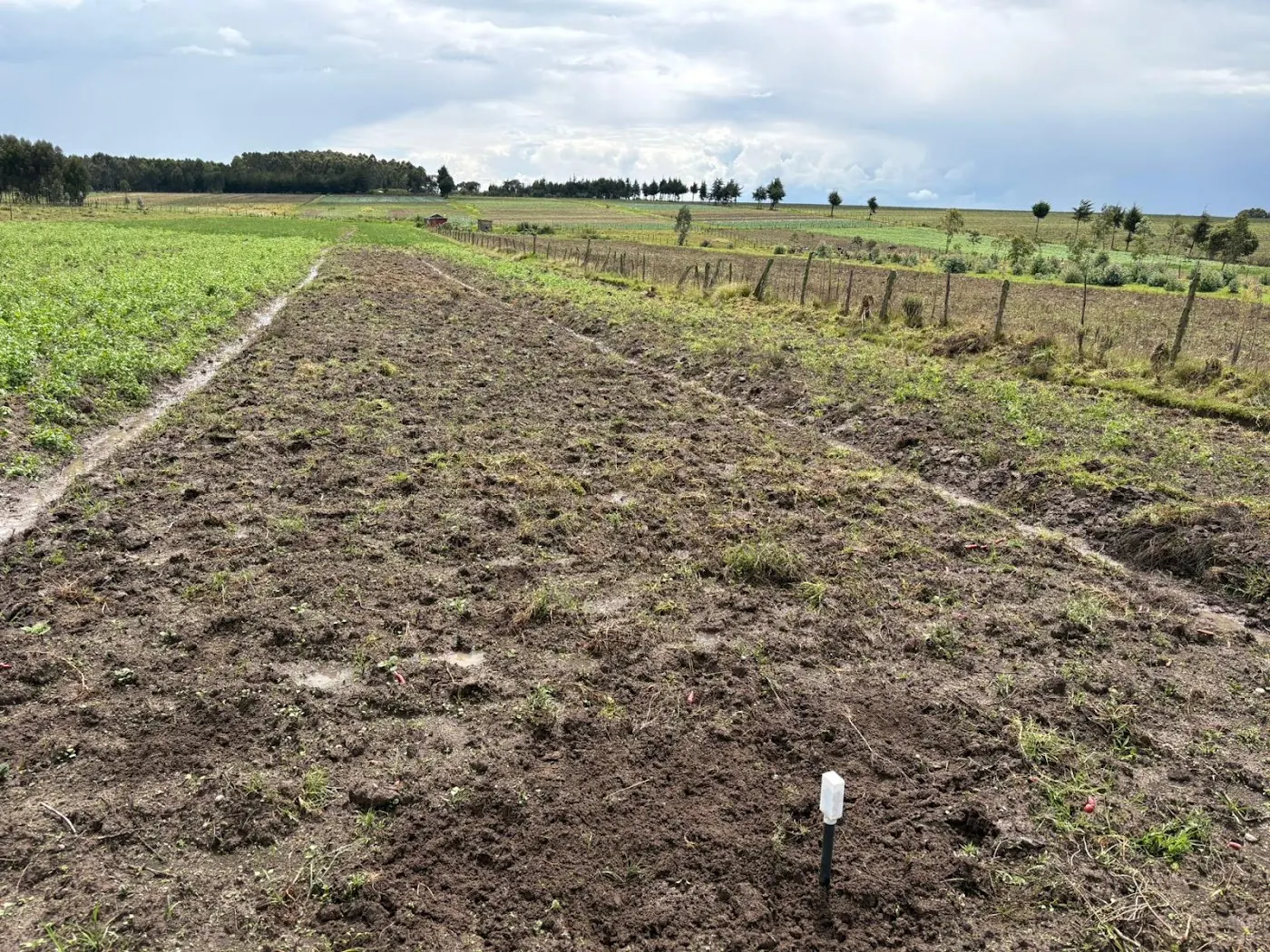
Productivity varies between plots in the same area more than people negotiating over tea admit. From 25 September to 25 October 2026, rainfall totals at 10 NuaSense weather stations in Kenya ranged from 0.0 mm to 61.7 mm. Those stations are not co-located and the spread is not a regional figure. Still, it shows what one month can do to two fields under different skies. Agree a rent on the assumption that both fields behave the same, and one tenant will regret it. The owner of the drier plot will not volunteer the difference.
Before you fix a figure, walk the plot with the crop in mind. Where does water stand after rain? Is there a store, a fence, a pump, a path a lorry can use? Who farmed it last, and why did they leave? Modelled soil texture and pH for a location are available from map products such as iSDA Africa at 30 m resolution. The NuaSense dashboard fetches those once when a station reports its position. They are modelled values of around 2016 vintage, not a soil test of that field. They belong in the first conversation, not the final one. The final one belongs to the soil you can see and the owner's honesty about the last three seasons. Ask for the last three, not the best one.
Thirty percent of gross: the one ratio you can redo on a phone
The University of Nebraska lease FAQ gives the only rent-to-income ratio in the whole source set. In a crop-share arrangement there, the landlord would typically receive about 30 percent of gross income. Gross income per acre is average yield multiplied by expected price. The FAQ adds the part most people skip: calculate that share as an average across five or more years, because both yield and price move. Thirty percent of a good year is a very different shilling figure from 30 percent of a drought year.
That 30 percent came out of Nebraska, and nothing in these sources shows it holds in Kenya. So do not adopt the number. Adopt the method. Work out your own average yield for this crop on land like this, multiply it by the price you can realistically get, and run the sum over several seasons rather than the one you happen to remember. The NuaSense guide to growing beans in Kenya puts yields at 0.6 to over 1.5 tonnes per hectare, depending on variety and management, and that is the spread a gross-income sum has to carry. County market prices are published free at agriculture-data.com and sit beside a farm's own readings on the dashboard, so the price side of the sum is not guesswork.
The same FAQ says to build a land-based rental rate out of three or four different factors and then decide, instead of leaning on any single method. For a Kenyan tenant, those factors are the averaged gross above, what comparable plots nearby actually let for, what it costs the owner to hold the land, and what the same money would earn as inputs on land you already farm. Work all four, then settle.
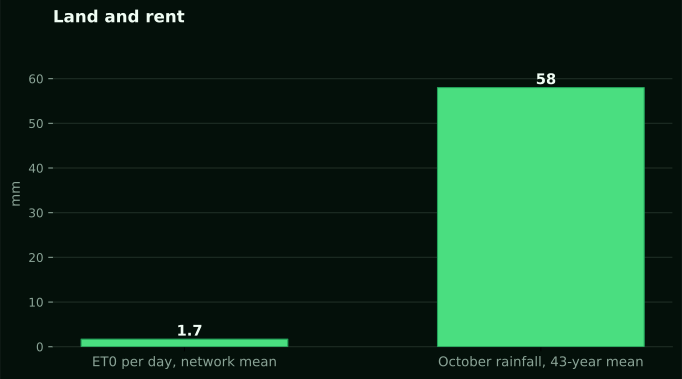
You can see the five-year averaging rule in Kenyan rainfall alone. Across the CHIRPS satellite-and-gauge record for the grid cells where NuaSense stations stand, October rainfall averaged 58 mm over 43 years, from 1983 to 2025. The driest October was 18 mm in 1996 and the wettest 293 mm in 2019. Any single season falls somewhere on that spread. Set a rent against the gross of one remembered year and you are setting it against a point, not a distribution. The owner will remember the wet year. You will remember the dry one.
Cash rent or share of the crop: who carries a failed season
The University of Nebraska lease FAQ draws the line cleanly. Under a cash lease, all the risk of production sits with the tenant. A crop-share lease splits that risk between landlord and tenant. A common share distribution there is 60 percent to the tenant and 40 percent to the landlord, and most expenses are typically shared in those same proportions. Hay land is usually let on shares, with the landlord taking between one-third and one-half of the hay crop. These sources describe share leases as Nebraska practice; nothing here says they are common in Kenya.
Even so, a share lease is worth putting to a Kenyan owner. On cash, a failed season costs the tenant twice: the lost crop and the rent already paid. On a share, the owner's income falls with the field, so the owner now has a reason to care whether the plot is fenced, drained and sprayed on time. An owner who takes 40 percent of the grain will answer the phone about the broken gate.
The objection you will hear from an owner is that a share is harder to check than cash. Fair point, and it is why a share lease needs a written harvest record, a weighing both sides witness, and an agreed price source. The arrangement only holds if costs and rewards move together. A tenant who proposes 60 to 40 on the crop and then asks the owner to pay nothing towards inputs is proposing a cash lease with extra paperwork.
Four ways to take the same acre, side by side
The choice usually reaches you as one offer, but there are four real options, and seeing them side by side changes which one you take. The rows below carry no shilling figures because the sources have none. The costs are described by who pays and when.
- Cash lease, paid before planting. Costs: the full rent up front, plus every input. Buys: control of the plot and the whole crop. Risk: all on the tenant, per the Nebraska FAQ. Right call when: you have averaged several seasons of gross and the rent is a modest slice of the worst of them.
- Crop share. Costs: a fixed share of the harvest, with inputs shared in the same proportion. Buys: a landlord with a stake in the season. Risk: shared. Right call when: the plot is new to you, the owner is nearby, and a witnessed weighing is possible.
- Handshake renewal of last season's terms. Costs: whatever you paid last time, plus whatever the owner now thinks the land is worth. Buys: continuity, no survey, no negotiation. Risk: the terms you did not renegotiate. Right call when: last season's sum still works and nothing nearby has changed hands.
- No lease. Costs: nothing paid out; the same money goes into inputs on land you already farm. Buys: a lower-risk season. Right call when: the derived rent exceeds what the margin can carry, or the lease terms would not be written down.
The fourth row is the one tenants forget to price. Rent is the only cost in the season paid before a seed is in the ground and before anyone knows what the sky will do. If the arithmetic on the averaged gross says rent takes most of the margin, the cheaper option is to farm fewer acres well. Sometimes the better season is to put that rent into inputs you can check, and the piece on spotting fake fertiliser and seed at the counter shows you how to do that before you pay.
The lines that are not the rent: fence, store, pump and repairs
Most lease arguments are about the headline figure. Most of the money that goes wrong sits somewhere else. The University of Nebraska lease FAQ lists the details. In a Nebraska survey, grain storage came included with the farmland lease in 31 percent of leases. Renting storage for an extra charge occurred in 40 percent. In some Nebraska areas, the tenant supplies pivot repair labour and covers the first $500 or $1,000 of repairs. The landlord covers major repairs. Where the tenant provides the engine for the pump, the rent is adjusted lower according to the age of the unit. Where a boundary fence is needed, the landowner helps pay one-half.
A Kenyan block has no centre pivot, but it has the same categories. There is a store or there is not. There is a pump, a borehole or a river line, and someone owns the engine. There is a fence, or livestock from the neighbour. Write each into the lease as its own line, with who pays and who repairs. A sensible default is the tenant pays the small repairs and the owner pays the large ones. The dollar thresholds are Nebraska's, so agree a shilling threshold you can both live with. The same FAQ names the five ownership costs a rental calculation has to account for: depreciation, interest, taxes, insurance and repairs. A tenant who knows that list can say which of the five the tenant is quietly covering, usually repairs, and ask for the rent to reflect it. The input bill, which the piece on whether cheaper fertiliser in the next county is worth the trip worked through for a single season, already sits entirely on the tenant under a cash lease.
A handshake lease has a calendar even if nobody wrote one
The clearest calendar rule in these sources comes from Nebraska. It maps directly onto the handshake tenancies most Kenyan tenant growers actually farm on. The University of Nebraska lease FAQ states that the deadline for terminating an oral farm lease there is September 1. Without a new conversation or handshake by that date, the lease renews automatically on existing terms beginning March 1. Those dates are Nebraska law and mean nothing in Nakuru. The lesson is not the date. The lesson is that an oral lease still has a termination point and a renewal point, and the side that knows when they fall controls the terms. In Kenya nobody has written those points down for you, which means the owner picks them, and the owner will pick the week before planting.
The World Bank study of Ukraine's land markets adds a warning. Informal lease contracts there can be a deliberate choice by owners. That lets them evade regulatory obstacles that would otherwise stop them renegotiating for more favourable terms. The owner who prefers not to write anything down may prefer it for a reason. For a tenant, the unwritten lease is the one where the rent can rise after the land has been ploughed and before the seed is in. Nothing in these sources says Kenyan law requires a written agricultural lease, and this piece does not claim it. It says a tenant should want one, and should fix a date by which either side must say the terms are changing, with silence meaning renewal as they stand.
Expiry is the moment to do it. The World Bank note on Malawi's estate sector records that most agricultural estate leases there have expired, creating a need to renew, cancel or renegotiate them. Three verbs, and only one of them is passive. A Kenyan tenant whose season is ending has the same three choices and one scheduled chance to use them. Arrive at that conversation with the averaged gross, the repair list and the fence line already on paper, and the renegotiation starts from your numbers instead of the owner's memory. Arrive with nothing and the owner names a figure, you nod, and the next chance is a year away.
Your rent can move because of a land sale down the road
What a tenant pays is set partly by forces that never enter the field. The World Bank study of Ukraine's land markets draws on more than 1 million lease and sales transactions rather than a survey sample. That was after Ukraine opened land sales markets and introduced land price reporting in 2020/21. Eliminating restrictions on land sales triggered short-term lease price increases of 10 to 20 percent. The authors say that is well above the direct effects of less far-reaching reforms reported in earlier literature. Higher transaction volumes at village level were linked to higher lease prices. Larger parcels, fields and farms fetched higher prices per hectare. Legal entities paid higher lease prices than individuals, and on average leased land in 12 villages.
None of that has been demonstrated in Kenya. The mechanism still deserves a Kenyan reading. If land near your block starts changing hands, because of a road, a town expanding or talk of compulsory acquisition, the Ukrainian evidence says lease prices in the area tend to follow, and quickly. A rent that rises for that reason has nothing to do with your yield, and saying so at the table is fair. The same study undercuts a comfortable assumption: tenants who already held registered use rights in a Ukrainian village paid lower rents, but that discount shrank as their share of village land use rose. The authors read it as an informational advantage, not market power. The grower who has farmed the next plot for years has a stronger hand than the outfit arriving with lorries. The study also finds that absence of registered rights generates negative externalities whose size plausibly exceeds the cost of registering all land. Whatever rights you can register, register.
Where the law stands, and when no lease is the right answer
The Kenyan sources here are narrow, and the article stays inside them. The Land Act 2012 as published by Parliament provides that where land reverts to the national or county government on expiry of a leasehold tenure, the Commission shall offer the immediate past holder pre-emptive rights to allocation, provided the lessee is a Kenyan citizen and the land is not required by the national or county government. That concerns leasehold tenure held from the state, administered through the National Land Commission, not a season's tenancy between two farmers. It matters to a tenant only because the owner's own title may be a leasehold with a date on it, and that date should be known before you commit a crop. The Ministry of Lands leasing guide separately defines a government lease as an agreement where a property owner rents to a government agency, a different animal again. None of these documents caps agricultural rent, sets a maximum term or requires a written lease.
What protects a tenant is mostly what the tenant puts in writing: a named rent and the date it falls due, cash or share, who weighs and stores, who runs the pump engine, who handles fencing and repairs as separate lines, a date for either side to give notice of a change, and the owner's title plus any expiry. Sometimes the right call is to decline. If the averaged gross shows rent taking most of the margin, if the owner won't put anything on paper, or if nearby land has started selling and the figure has already jumped, then farming your own acre properly is the better season. The NuaSense dashboard costs nothing to use and shows county market prices alongside a farm's own readings; the sum needs only the price data, and the hardware is a separate decision.