
One acre, one crop, one season: fix the unit before any number
Work out gross margin per acre with a single subtraction. Start with what one acre brings in, subtract every shilling you spent only because that acre was planted, and the remainder is the gross margin. CABI's farm business management slides define it as gross revenue minus variable costs for a unit of an enterprise, with the unit a technical one such as a hectare. In Kenya the unit is the acre. Land is leased by the acre, labour is quoted by the acre, and the agrovet counter thinks in acres. Before a single shilling goes on the page, choose one acre, one crop and one season, and write all three at the top. Every figure below has to belong to that acre and that season. Otherwise the subtraction means nothing.
Two items are deliberately left out. Rent and the loan on the water pump stay the same whether the acre grows beans or sorghum, so put them in a separate column headed fixed costs. A Yale School of Management primer on breakeven analysis roots the whole method in the split between fixed and variable costs. That split is what lets you compare one crop with another. It is also what makes gross margin a poor measure of whether the farm made money. Revenue minus variable costs is not profit, and the two get confused on every budget sheet handed across a counter.
The worked example below comes from one Kenyan French bean study. It is the only Kenyan budget in the sources with every line printed: a yield range, a farm-gate price, a variable cost total and a labour breakdown. Its shillings belong to an older price level, so replace them with this season's quotes. Copy the sum, not the figures.
Yield: write down the low end of the range
Most budgets go wrong at the yield line before anyone touches price. A financial analysis of French bean production in Kenya gives average yield as 600 to 1,000 cartons of 3 kg per acre. That is a range, and an honest budget carries both ends right down to the bottom of the page. Stop writing 1,000 just because the exporter's field officer mentioned it. Put 600 in the first column and 1,000 in the second. Do not average them. An average hides the season that goes badly.
A national series shows the same trap at a larger scale. The USDA crop production summary for 2025 calls 53.0 bushels per acre a record high for soybeans, up 2.3 bushels from 2024, on 80.4 million harvested acres, down 7 percent on the year. A record average is still an average. Many farms inside it harvested less. Any one of them that budgeted on the national figure overstated revenue. No Kenyan series of that kind is in the sources. That is a second reason to budget on the low end instead of hunting for a benchmark that is not there.
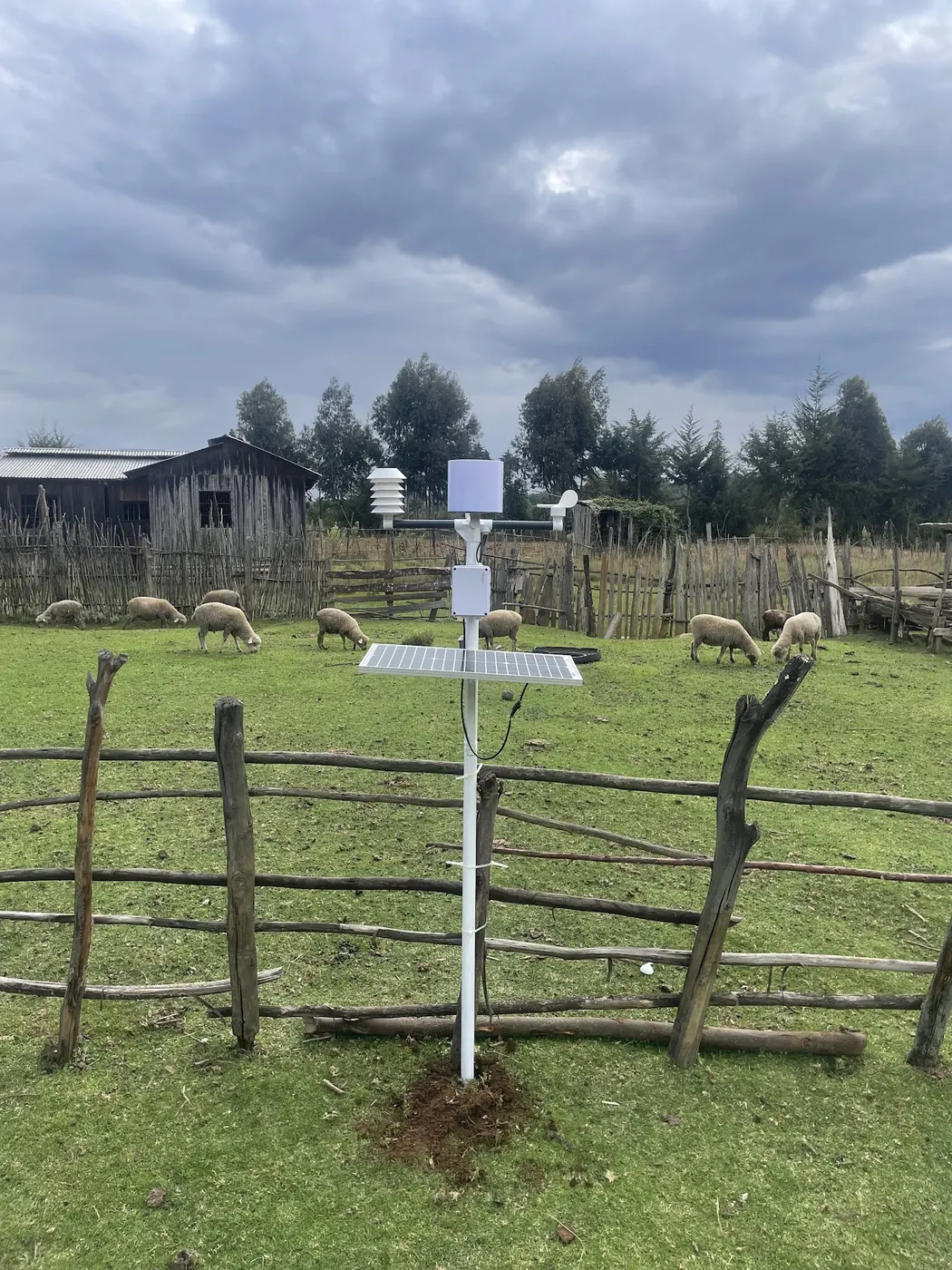
Conditions from the study do not travel either. Its farms were near Nairobi, at altitudes between 1,000 and 2,000 metres, on well-drained soil rich in organic matter, and they irrigated at about 50 mm a week by overhead or furrow. Fifty divided by seven is a little over 7 mm a day. Reference evapotranspiration computed from NuaSense weather stations averaged 1.6 mm per day across 14 stations over 02 October to 01 November 2026. That is reference ET0, not crop water use, and not directly comparable. Still, it says plainly that the study crop was generously watered. A block without that water has no claim to the top of the range. It should think hard about the bottom.
The price that counts is the one paid at your gate
The same study recorded a farm-gate price of Kshs 21 per carton of 3 kg. Read what that number is: farm gate, per carton, at the pack size the exporter collects. It is not the Nairobi price and not a European shelf price. A budget that borrows either one is fiction. Some small farmers in the study had direct access to export markets. The majority sold to exporters, which is a polite way of saying the grower takes what is offered.
Buyers set that price for objectives that are not yours. FAO's chapter on pricing decisions lists six groups of pricing objectives: profitability, volume, competition, prestige, strategic and relationship. It observes that when a target selling price is set first, that price becomes the principal determinant of product formulation, packaging, promotion and distribution. An exporter who has promised a shelf price abroad works backwards from it. The farm-gate figure is what remains after the exporter's own margin and freight. Your price is the leftover of someone else's sum. The same chapter puts typical commercial targets at a 20 to 25 percent annual return on investment after tax and a 5 to 8 percent return on sales. A buyer chasing those targets will press the farm-gate figure before touching its own.
Start with the lowest price a buyer has really paid a grower like you this season, at your gate, for the grade you will deliver. The neighbour who sold last week can tell you. So can the agrovet, who hears every complaint. If the only figure you have is the buyer's pre-season quote, mark it unconfirmed and put a lower number beside it. Kshs 21 is a historical number. Its job is to show how a price enters the sum, not to tell you what to expect.
Revenue is a multiplication you do twice
Revenue is yield times price, and you do it twice because yield is a range. Low column: 600 cartons times Kshs 21 gives Kshs 12,600 per acre. High column: 1,000 cartons times Kshs 21 gives Kshs 21,000 per acre. The price never moved. Yield alone opened that gap, and that gap is the reason you carry both columns.
A per-acre figure and a per-unit figure are the same money seen from two sides. A Florida avocado cost and profitability analysis reports a return of 325 per acre, or around 0.08 dollars per pound of marketable fruit, and calls it a 34.9 percent return on the total cost of producing and marketing the crop. Packers talk per pound. Growers live per acre. In Florida, 93 percent of avocado growers farm less than 15 acres and 72 percent less than 5, so the per-acre view is the one most of them need. That is also where a French bean grower on a small block near Nairobi stands. Those Florida figures are a contrast, not a benchmark: different crop, costs and currency. On your own sheet, write revenue per acre in both columns and put the price per carton beneath, so that when you test sensitivity later one moves and the other visibly follows.
Variable costs: the lines that disappear if you do not plant
A variable cost is any shilling you spend only because the acre got planted. The French bean study prints these lines: land preparation at about Kshs 500 per acre, fertiliser at Kshs 500 per acre, a seed rate between 20 and 25 kg per acre, irrigation across 20 applications, spraying, weeding, top dressing and harvest labour, totalling about Kshs 4,670 per acre. Seed cost shows up only as Kshs 32 for 60 kgs, and that cannot become a per-acre line without assumptions the study does not state. Leave it there as a reminder to price seed at your own agrovet.
Every line needs this season's price, and fertiliser is the one that moves most. An earlier piece on whether the cheaper fertiliser in the next county is worth the trip weighed transport and time against the bag price. The piece on spotting fake fertiliser and seed before you pay explains why the cheapest quote is sometimes the most expensive line on the sheet. Background on what a bag should contain sits on our fertiliser page. Put the price you were quoted this week in the column, with the shop's name beside it, so next season you can see which line moved.
Two questions decide whether a cost belongs here. Would it vanish if the acre stayed fallow? Does it roughly double with two acres? Family labour fails the first test in many households, because those hands get fed either way. That is why so many Kenyan budgets leave it out and show a margin that would not survive hired labour. Write family hours down at the going casual rate, even when no cash changes hands. A margin that only holds while your children pick for free disappears the year they are in school.
Harvest labour: 92 percent of the hours on a French bean field
This is the most useful table in the sources, and it changes what the money decision is about. On a large mechanised farm in the French bean study, total labour was 3,283 man-hours per hectare. Harvesting alone, meaning picking, selecting and packing approximately 1,300 cartons for export, took 3,030 of those hours. Divide 3,030 by 3,283 and you get a little over 0.92. Ninety-two percent of the labour on a French bean hectare happens at harvest.
Everything else is small beside that. Irrigation takes 80 man-hours per hectare across 20 applications, which is 4 man-hours per application. Weeding 35, spraying 14, top dressing 9, planting 7. Canning, where it happened, took 100. The study calls the crop labour and capital intensive, and this table shows which half of that phrase carries the weight.
Here is what that does to the budget. Harvest labour is the one variable cost that climbs with yield, because more cartons mean more picking, and it is also the one you cannot push back. Beans picked late are beans the exporter rejects. So for French beans, the gross margin question is partly a scheduling question. Can you get enough hands onto the block on every picking day, right through an export season the study says runs from November to April? If you cannot, the top of the yield range is closed to you no matter how good the soil is, and your budget should carry the low column only. Many budget sheets handed out by buyers price the inputs carefully, then leave harvest labour as a single line with no hours behind it. On this crop, that line is the budget.
Irrigation is the only labour line that falls when you water less often: 4 man-hours per application per hectare. And whether an application was needed is a question the soil can answer before the labourer is hired. That is the one place a soil reading gets into a gross margin sheet, and it comes in as hours saved, not as a product. Next to 3,030 hours of picking, 80 hours of irrigation is a small line. Anyone selling you an instrument on the strength of the irrigation line should be asked to say so.
Subtract, and look at the gap between the two answers
Now subtract. Low column: 600 cartons at Kshs 21 gives Kshs 12,600, and 12,600 minus the Kshs 4,670 variable cost leaves Kshs 7,930 per acre. High column: 1,000 times 21 gives Kshs 21,000, and 21,000 minus 4,670 leaves Kshs 16,330. The study itself reports the gross margin as 16,530 Kshs per acre. That is 200 shillings above what its printed inputs produce (16,530 minus 16,330), and the excerpt does not say where the difference comes from. Write both figures down, and prefer the one you can rebuild from the lines above it.
One thing the study cannot support: its variable cost total did not move between the columns. Yet harvest labour scales with cartons, so a proper sheet carries a higher cost in the high column, which leaves the range above a little too wide at the top. Say so on the page. An honest note beside a figure is worth more than a figure that looks finished.
Set the result beside the other Kenyan margins in the sources and the gap between crops is as wide as the gap within one. A Kenyatta University profitability analysis of pigeon pea found a gross margin of KES 3,470.60 per acre in Machakos County. Makueni County's 2023 gross margin document for field crops lists a gross margin per acre of Ksh 13,970.00 beside a one-acre Gadam sorghum budget. French beans at the low column sit between those two, and at the high column above both. Different crops, counties, years and price levels, so none of the three compares directly. Together, though, they bracket what a Kenyan acre of field crop has been shown to return above its variable costs. A budget that lands far outside that bracket deserves a second look at its inputs before it deserves any excitement.
Check the units before you copy anyone's table
One sentence of the French bean excerpt is worth more than any clean figure in it. It gives the gross margin as 16,530 Kshs per acre and, in the same breath, as Kshs 1,309.6 per hectare. Both cannot be right. Elsewhere the study converts consistently: Kshs 4,670 per acre becomes Kshs 11,539.6 per hectare, and 11,539.6 divided by 4,670 is 2.471, the number of acres in a hectare. Multiply 16,530 by 2.471 yourself and you will not arrive anywhere near 1,309.6. Somewhere between field and page a digit dropped, or a column was mislabelled.
A grower who copied the per-hectare figure into a hectare budget would have walked away from a crop that paid. One who copied the per-acre figure into a hectare sheet without converting would have expected far too little in the other direction. Same mistake either way: a number without its unit.
So before any figure from a county document, a study, an exporter's handout or a WhatsApp group goes onto your page, write the land unit, the pack or weight unit, the currency and the year beside it. Missing one of the four, it is not ready. FAO's farm management and marketing manual notes a gross margin may be expressed per acre, per day or hour of labour, per dollar of capital, per dollar of working capital or per dollar of fixed capital, and tables do not always say which they chose.
Break-even yield: the carton count that pays the costs back
Break-even means the yield where revenue matches variable cost and margin sits at zero. Take cost and divide by price. Kshs 4,670 divided by Kshs 21 per carton gives 222.4. So 223 cartons of 3 kg cover variable costs. Carton 224 is the first one that puts something toward rent, the pump and the family. Set that against the low end of the study range, 600 cartons, and the cushion is wide. That is why French beans were worth planting in that study.
Break-even also brings the fixed-cost column back into play. The Yale primer starts break-even from fixed and variable costs for a reason. A crop can show a strongly positive gross margin and still leave the farm short when the fixed costs it has to carry are bigger than that margin. Enterprise break-even is 223 cartons. Farm break-even is 223 plus whatever extra cartons pay the lease and the loan. Only your own fixed-cost column gives you that second number. No published table can.
Turn it around and ask what price covers costs at a set yield. At 600 cartons, Kshs 4,670 divided by 600 comes to Kshs 7.78 per carton. At 1,000 cartons, 4,670 divided by 1,000 comes to Kshs 4.67. Those are floor prices. Below them the acre loses money on variable costs alone. They matter when an exporter's quote lands mid-season. The question then is not whether the price is good. It is whether it sits above the floor for the yield you now expect. A buyer who knows your floor better than you do will price to it. Work it out first, and keep it to yourself.
Sensitivity: move price and yield one at a time, never together
Sensitivity is the step phone budgets skip. It tells you which number to worry about. Move one input and hold the rest. Start with price. At 1,000 cartons, every shilling off the carton price takes 1,000 shillings off the margin. At 600 cartons, every shilling off takes 600. A high-yield grower is more exposed to price in absolute shillings than a low-yield grower. That is backwards from how most people feel about it.
Now hold price steady and move yield. Every carton lost costs Kshs 21 in revenue. It also saves the picking and packing on that carton. From the labour table, that is the bulk of the per-carton work, so the margin falls by less than the revenue does. Nothing softens a price cut. Every carton still has to be picked at the same cost. Between the two, price is the input to lose sleep over on a labour-heavy export crop. It is also the one you control least.
Crop choice is the sensitivity that comes before either. Purdue's 2024 crop cost and return guide reports contribution margins. That is its name for revenue minus total variable cost. The figures run from 217 dollars per acre for continuous corn to 442 dollars per acre for wheat followed by double-crop soybeans on Indiana ground. Those are American figures, and they stay in Indiana. What travels is that rotation alone roughly doubled the margin, before any price moved.
Margin per acre, per hour of work, per shilling: three rankings that disagree
Ranking per acre is the landowner's view. FAO's list gives per acre, per hour of labour and per shilling of working capital. Those measure three different farms. A grower short of land ranks crops per acre. A grower short of cash ranks them per shilling spent. That is margin divided by variable cost, and you can do it in both columns from figures already on the page.
A grower short of hands ranks per hour. Here the French bean numbers turn, so convert the labour total to the acre. Take 3,283 man-hours per hectare and divide by 2.471. That gives about 1,329 man-hours per acre on the large mechanised farm. A low-column margin of Kshs 7,930 (600 times 21, minus 4,670) spread over 1,329 hours comes to roughly Kshs 6 an hour. A high-column margin of Kshs 16,330 (1,000 times 21, minus 4,670) over the same hours comes to about Kshs 12. Hours and margin come from the same study but not necessarily the same farms. So treat this as an order of magnitude, not a wage. That order of magnitude is the lesson. A healthy margin per acre can be a thin one per hour when nine tenths of the work is picking.
The farmers in the study were clear about it. Most put profit at around 25 percent, and even so they called the work the crop created, for themselves and for the people around them, a very important benefit. So you have a volume goal sitting beside a profit goal. The FAO pricing chapter finds the same pair in machinery makers, who hold volumes up at the cost of potential profit so factories stay running and a skilled workforce stays employed. When a household has hands to occupy and nothing better to do with them, choosing the labour-heavy crop is a rational choice, as long as the sheet says so in writing.
Potatoes are the counter-example most readers reach for first. The World Bank farm budgets handbook gives a worked example with a 117 dollar per acre gross margin for the Sebago variety. That figure was measured where the handbook was written, not on a Kenyan block. The NuaSense guide to growing potatoes in Kenya goes through the varieties, fertiliser strategy and disease control that decide where on a Kenyan potato yield range you end up. Build your potato sheet the same way, two columns, and compare per acre, per shilling and per hour before you decide.
Where the sum goes wrong
Mistakes in a gross margin sheet come from a short list, and most of them showed up somewhere above. Check your own page against it before you pay for seed.
- Only the top of the yield range on the page. A 1,000-carton budget on a block that has never picked 600 is a loan application, not a plan.
- A price from the wrong place in the chain. Nairobi wholesale, the exporter's pre-season promise and the shelf price abroad are three numbers, and none of them is the farm-gate price.
- Units copied without labels. One published sentence carrying 16,530 per acre and 1,309.6 per hectare shows how easily it happens; a WhatsApp forward does it more often, with less to check against.
- Family labour at zero. That margin survives until the day the hands have to be hired.
- Fixed costs smuggled into the variable column, or dropped from the farm altogether. Rent, the pump loan, and a NuaSense weather station at KES 30,000 or a soil sensor at KES 7,000, both excluding taxes, are fixed costs: they belong in the other column, and the gross margin on one acre cannot tell you whether to buy them. Only the fixed-cost column, set against the margin from every acre an instrument covers, answers that, and on a single small block the answer may well be no.
- Gross margin read as profit. Farmers in the study estimated profit at about 25 percent on a sheet whose margin stood well above its variable cost, and both statements were true at once.
- Last season's sheet reused with the old prices still in it. One Acre Fund's introduction to East African smallholder agriculture describes loan repayments digitised over mobile phones, a reminder that the working capital in the variable cost column is often borrowed, and borrowed money carries a season and a repayment date.
Then there is the quiet failure: running the sum once, after harvest, just to see how it went. Gross margin per acre is a planning tool. Work it out before the seed is bought, keep the low column honest, label the units and mark the price confirmed or not, and it tells you which crop, which acre and how many hands. Work it out afterwards and it is a receipt.