Measured by NuaSense weather stations and soil probes on Kenyan farms, over the period stated with each figure. Past readings, not a forecast.
The decision as it reaches the agrovet counter
You'll hear this question at the agrovet, not from an insurer. A grower buying seed and a bag of DAP for the long rains gets offered crop insurance in Kenya right there at the counter. It comes as an add-on, priced per acre or folded into an input loan, and they have about a minute to decide. But the real decision is older than the product. Do you hand a sum of money to someone else before the season starts, in exchange for a conditional promise? Or keep that same sum in a sacco account, against the season going wrong? That choice is what this piece is about, and nothing else.
First, a warning about figures. We could not find a source we'd stand behind that publishes a premium rate, a sum insured or a subsidy share for a Kenyan smallholder product, so there isn't one here. The agent in front of you has a quote. Treat it like the piece on fertiliser prices across counties treated a cheaper bag two counties away: one line in a longer bill that you have to finish yourself. The rest of this article is the rest of that bill.
Two products, two different promises
An index policy doesn't insure your crop. It insures a number. A Strathmore University thesis on pricing premiums for smallholder index insurance puts the mechanism plainly: the purchaser, say a smallholder maize farmer, gets a payoff if rainfall measurements fall below the trigger amount. Read that twice. The payoff follows the measurement. Nobody comes out to look at the maize. If the gauge reads above the line and your field burnt because the rain fell in the next valley, you get nothing. If the gauge reads below the line and your field did fine because you irrigated from a dam, you still get paid. That's the trade: speed and low administration, in exchange for a payout only loosely tied to what you actually lost.
A yield-based policy insures a yield figure, for your field or your area. To get paid, a shortfall has to be established. That means a visit, a sample cut, a report and a settlement. It can cover losses an index never sees, but only after a process you don't control.
The practical difference comes down to causes. A rainfall index pays for one cause and one only: the index moving. Disease, hail on your plot alone, theft, poor seed, a late planting that missed the rain the gauge recorded. None of these move it. The potato growing guide on nuasense.com spends much of its length on disease control and planting seasons, and almost everything it warns about would be invisible to a rainfall index. Before you pay for any policy, write down the loss you're actually afraid of this season. Then ask yourself whether the product would notice it.
The gauge that decides your payout is probably not on your farm
The oldest working index product is livestock, not crops, and it shows the principle without softening it. Mongolia's index-based livestock insurance, described in the World Bank appraisal of national crop and livestock insurance options for Kenya, relies on a mortality rate index by species in each local region. Individual herders get a payout based on local mortality, whatever their own losses were. A herder who lost every animal in a region that lost few got little. A herder who lost nothing in a region that lost many got paid. Rainfall indices in Kenya run on the same logic with a different variable.
Ask the agent how far your field can sit from the reference measurement before the index stops describing your season. That's the thing to ask, and the thing the agent is least likely to know. Our own instruments show why it matters. Across 10 NuaSense weather stations in Kenya, from 18 September to 18 October 2026, station rainfall totals ranged from 0.0 mm to 75.3 mm. Those stations aren't co-located, and the spread is a measured difference between individual sites, not a regional figure. But it's exactly the kind of spread an index product has to average over. Over the same period, only 197 of 12,240 ten-minute readings recorded any rain at all. That's 1.6 percent of readings. Rain in that month came in short events, and a short event lands on one farm and misses another.
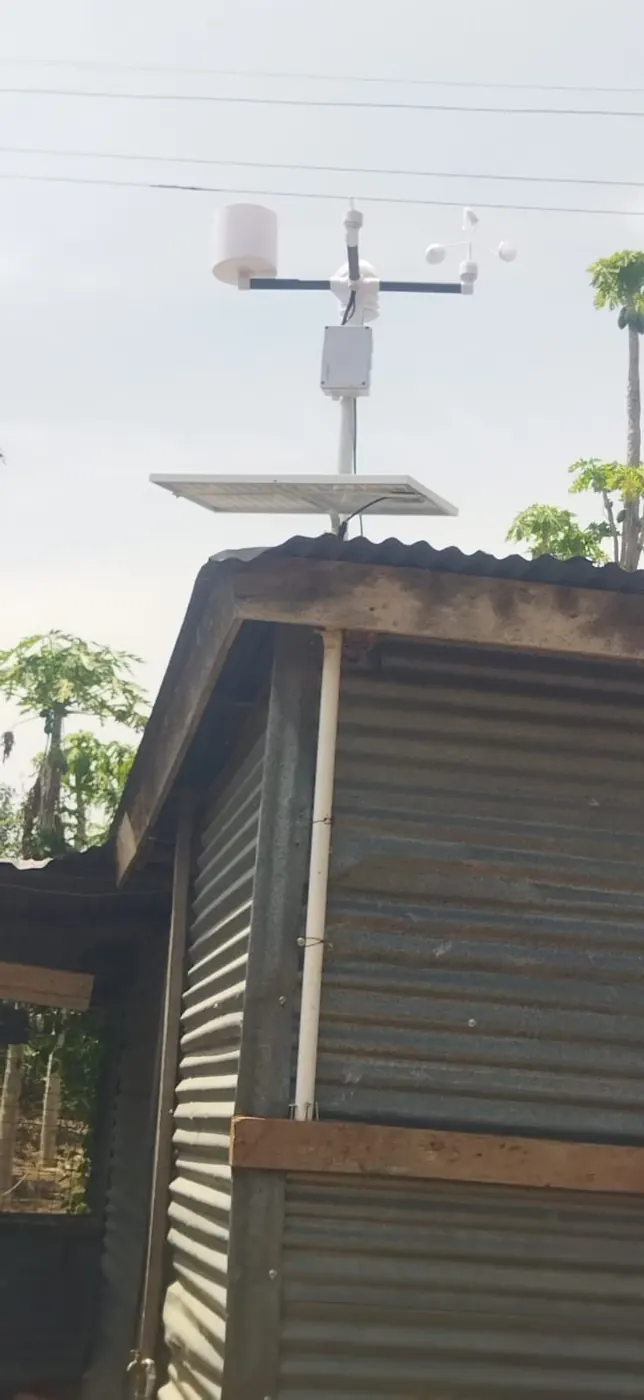
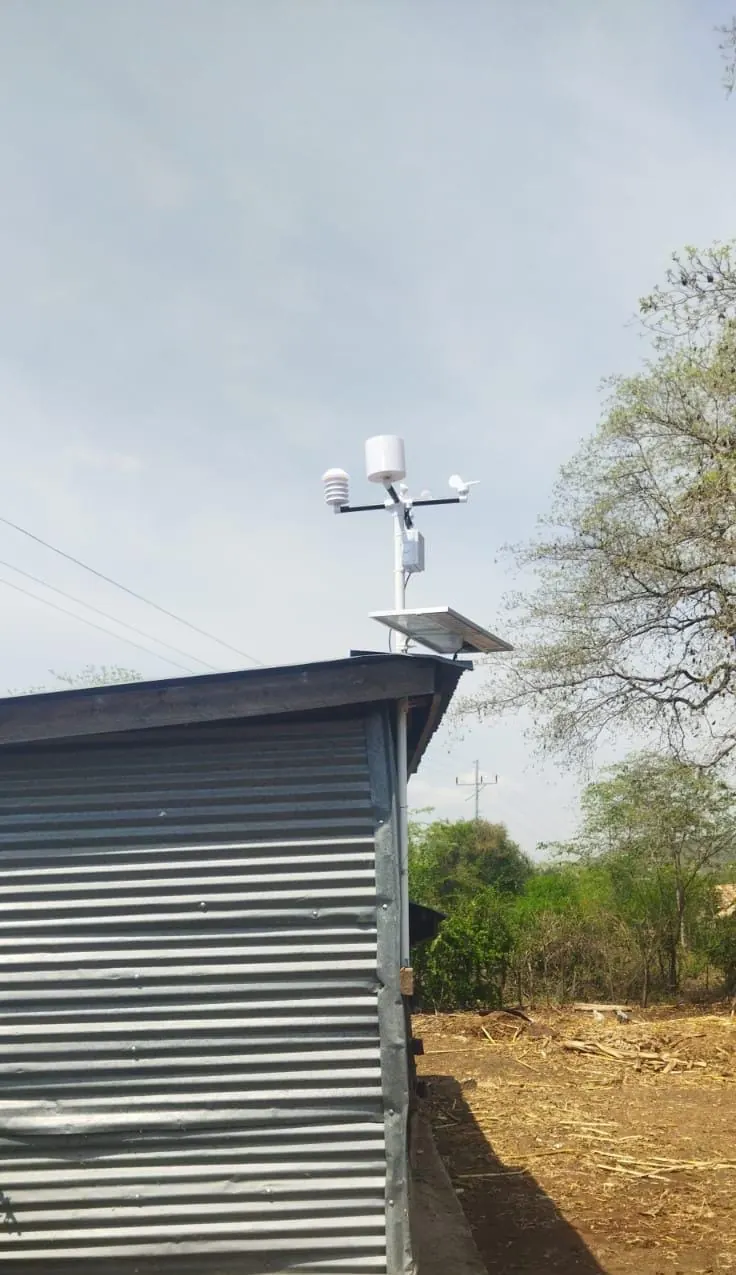
This is the one place a weather station earns its keep in an insurance decision. A station on your own farm (KES 30,000 excluding taxes, reporting rainfall in millimetres roughly every 10 minutes) won't win you a claim. The contract pays on the reference gauge, not yours. What it gives you is a dated record to hold against the index after the season. By the second or third year, you'll know whether the product has been describing your rain or someone else's. That's evidence for the renewal decision, not for a dispute.
Who actually settles a yield claim
People decide a yield-based payout, and the Government of Kenya's own policy drafting names them. The draft National Agriculture Insurance Policy published by the Ministry of Agriculture lists the insurance service providers that supply technical services to the insured and the insurer both: risk managers, loss adjusters, calculating agents, crop cutting agents, insurance surveyors, investigators and claims settlement agents. A claim goes through that whole chain. It does not rest with the insurer alone.
For a grower, this changes who you chase and when. The crop cutting agent sets the yield figure, and the sample they cut is the number everything downstream uses. Miss the cut, or fail to find out which part of the field was sampled, and you have lost the argument before it starts. The loss adjuster turns that figure into a loss against the insured yield. The claims settlement agent releases the money. Each one is a separate person, possibly a separate firm, and a delay at any link looks to you like the insurer refusing to pay.
Before signing, ask three things. Who cuts the sample, and will you be told the date in advance. What yield figure the policy insures, and where that figure came from, since a shortfall is measured against it. And which firm settles the claim. An index product skips this whole chain. That is its main advantage, and the main reason it is cheaper to run.
Why a small plot is the expensive customer
Growers assume insurers avoid smallholders because the risk is high. The policy document says something different, and more useful. The same Ministry of Agriculture draft policy states that for small insured farm units the premium volume generated is low and therefore insufficient to cover the costs the policy has to carry. Your acre is not riskier than a large farm's. The trouble is that the premium on one acre cannot pay for the agent's visit, the paperwork, the crop cut and the settlement, let alone the reinsurance behind it.
That one sentence explains what you meet at the counter. Minimum acreages: below a certain size, the fixed costs exceed what the premium can carry, so the product is not offered. Cover bundled with an input loan: the lender already has the paperwork, the visit and the collection, and the insurance rides on it. Index products dominating the smallholder market: with no field visit, the cost drops and a small premium becomes viable.
The implication is sharp. Make a premium low enough to be affordable on a smallholder plot and something has been removed to get it there. Usually the thing removed is the link between the payout and your own field. You are not getting a bargain. You are getting a different product. A grower who understands that may still buy it, because a loose promise that pays quickly can be worth having. Nobody should buy it believing it insures their crop.
Someone else may be paying part of your premium
The quote you are given is not necessarily the cost of the cover. The World Bank country profile of Kenya's agricultural insurance programme sets out three major roles for the Government of Kenya under the crop insurance programme, and the first is to finance and collect the requisite funds. The Kenya Agricultural Insurance Program, described in a CGIAR review of scalable agricultural insurance, is built as a public-private partnership bringing together government, insurance companies and development partners, with a stated aim of affordable, tailored insurance. Affordable, with government and donors in the partnership, means somebody other than the farmer is carrying part of the bill.
Every large programme was built this way. The World Bank appraisal notes that in China, support and premium subsidies from central and provincial governments grew the agricultural insurance market into the second largest in the world, after the United States, by 2008. It also warns that the literature is heavily biased toward a few very large public-private programmes in Northern America and Europe driven by large public subsidies. That finding comes from a 2008 survey of programmes in more than 65 countries.
That leaves two questions. First, is the premium you are quoted the full price, or is it subsidised? Ask. If it is subsidised, the cover costs less than its true cost, and that tips the sum toward buying, at least this season. Second, what happens if the subsidy stops? A budget decision in Nairobi or at a development partner can move the price between one season and the next. Buying while it is cheap makes sense. Assuming it will stay cheap does not.
Three layers of loss, and which one your premium buys
For a grower reading on a phone, the most useful idea in the whole literature comes from the way Mongolia stacked its risk. The World Bank appraisal describes the programme, designed inside a World Bank lending operation and piloted in 2005, as combining self-insurance by herders, market-based insurance and social insurance. Herders carry small losses. Larger losses pass to the private insurance industry. Extreme or catastrophic losses go to the government through a public safety net programme. A syndicate pool protects the insurers against excessive losses, excess-of-loss reinsurance comes from the government, and a contingent credit facility protects the government's own exposure.
Strip the institutions away and three layers remain. They apply to a maize plot in Trans Nzoia as much as to a herd in Mongolia. The bottom layer is the ordinary bad season: a bit less rain, a bit less yield, a thinner margin. You carry that whether you buy cover or not, because no affordable policy pays for small shortfalls. The top layer is the disaster that ends the farm: the season with nothing to harvest and a loan due. In Kenya, that layer is where government relief and safety nets operate, unevenly and late, but outside any policy you buy. The premium you are being asked for buys the middle: a loss too big to absorb from one season's margin and too small to attract relief.
So the real question at the counter is whether your farm has a middle layer worth insuring. A grower with a reserve equal to a season's inputs already covers the bottom layer and some of the middle. For that grower, a premium is buying a sliver. A grower with no reserve and a loan secured on the harvest has a wide, exposed middle layer. For that grower, a policy makes sense even at a price that looks poor on paper. The same product, offered to two neighbours in the same county, is a good buy for one and a waste for the other. The difference is not the product. It is what each already holds in reserve.
Uptake tells its own story. In the first sales season of the Mongolian pilot, 7 percent of herders in the three pilot regions bought the product. That figure belongs to Mongolia and to that season, and it says nothing about Kenya directly. What it does suggest is that most people, offered a middle-layer product for the first time, decided their own reserve was the better bet, or had no spare cash to decide anything. Neither reaction is foolish. The thin Kenyan evidence points the same way: a 2021 University of Embu study on participation in weather index insurance in Embu County examined how multiple factors influence whether smallholders join. That the question still needed asking tells you the market has not yet earned the trust it is selling.
Side by side: reserve, index, yield cover
No published Kenyan figure lets this table carry a shilling value. So it carries what each option costs in kind, what it pays for, and what it quietly leaves out. Read each row against the loss you wrote down earlier. The reserve row is the benchmark. It is what you have by doing nothing, and any policy has to beat it on the loss you actually fear, not on the loss the brochure describes.
- Keep the premium as a reserve. Cost: the money sits idle, earns whatever the sacco pays, and is tempting to spend. Pays for: any loss at all, from any cause, on your field, on your timing, with no paperwork. Does not pay for: a loss larger than the reserve. Best when: your biggest fear is disease, price or a one-off setback, and a single bad season would hurt but not end the farm.
- Rainfall index policy. Cost: a premium per acre fixed before the season, often the lowest quote, sometimes subsidised, sometimes a condition of an input loan. Pays for: the reference gauge reading below the trigger, quickly, with no field visit. Does not pay for: rain that failed on your plot but not at the gauge, disease, hail on your field alone, poor seed, a late planting. Best when: drought is the loss you fear, the reference measurement is close enough to describe your rain, and you have checked it against your own record for at least a season.
- Yield-based policy. Cost: a higher premium to carry the visit, the crop cut and the settlement chain, with minimum acreages below which it is not offered. Pays for: a confirmed shortfall against the insured yield, whatever the cause, provided the chain confirms it. Does not pay for: a loss the crop cutting agent did not sample, a shortfall against an insured yield set too low, or anything fast. Best when: the plot is large enough to qualify, you can be present for the cut, and the causes you fear are the ones an index would miss.
Two patterns stand out when the rows sit together. The reserve wins on breadth and loses on depth: it covers every cause and no catastrophe. The index policy wins on speed and price and loses on relevance: it may pay in a year you did not need it and withhold in a year you did. The yield policy sits closest to what growers imagine insurance to be and furthest from what a one-acre plot can usually buy. None of the three is wrong. Each is wrong for a particular farm, and the table is there to show you which.
Running the reserve sum on your own phone
No Kenyan comparison has been published that settles whether a premium beats a reserve, and we will not pretend one exists. What can be laid out is the shape of the sum. A reserve accumulates. Set aside the quoted premium every season, and if the index never triggers, after five seasons you hold five premiums, less whatever you dipped into. A policy resets to zero every season. Five premiums paid with no trigger leave you with five seasons of cover that expired. The reserve is behind the policy only in the season a trigger would have paid more than the reserve holds. That is the whole comparison. It turns on how often the bad season comes and how big the payout is against what you would have saved by then.
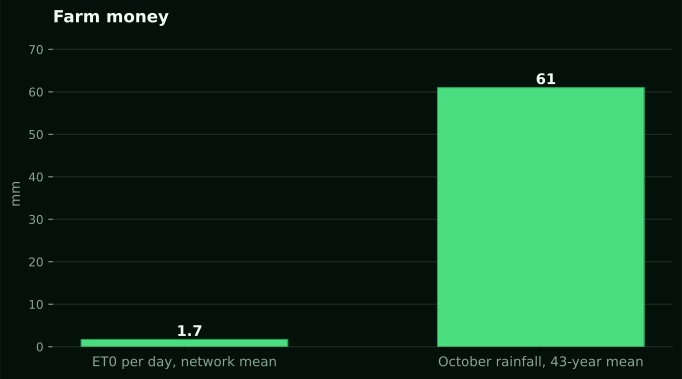
For how often it rains, don't lean on memory. Go and look at a long record for your own area instead. At the grid cells where our weather stations sit, the CHIRPS satellite-and-gauge rainfall product puts the October average at 61 mm across 43 years, from 1983 to 2025, with the driest October at 20 mm in 1996 and the wettest at 290 mm in 2019. Those are modelled cells, not our gauges, and they are not your farm. But the shape tells you something: a long run of ordinary years, then one very dry one and one very wet one, both a long way from the middle. A reserve built up over the ordinary years is what pays for the outlier. Whether it is big enough by the time that outlier lands is the gamble on the reserve side.
On how big the payout is, only the policy wording gives you an answer, and this is the place to dig in your heels. Ask what the trigger is, what the maximum payout per acre is, and how the payment scales between those two points. A policy whose maximum sits low against its premium is a poor stand-in for a reserve, even in the bad year. A high maximum plus a trigger that matches your own rain is the one case where the reserve clearly loses, because no smallholder saves fast enough to cover a total failure in year one.
When to buy, and when to keep the money
Buy when the policy is a condition of credit you would take anyway; the premium is part of the loan's price then, and the real question is whether the loan is worth it. Buy when a single failed season would end the farming, since a loose index payout beats nothing. Buy a rainfall index when drought is the loss you fear and your own record shows the reference measurement tracks your rain. And buy while the premium is subsidised, knowing the price can change.
Keep the money when the loss you fear is disease, price, labour or theft. No index notices those, and a yield policy on a small plot is usually out of reach. Keep it when the agent cannot tell you where the reference gauge is. Keep it when the premium is the full unsubsidised cost and you already hold a reserve close to a season's inputs. Keep it too when nobody will give you a plain answer on the trigger, the maximum payout and who settles. The same discipline runs through the piece on counting pests before deciding to spray: what justifies a purchase is a measured threshold, not the fact that a product exists.
One yardstick for judging the offer: the World Bank road map for Kenya aims at institutions covering at least a fifth of the country's agricultural producers. A product that is part of a national programme should look built for many, with public backing visible in it, not like a one-off sold at one counter. Your scepticism is reasonable, so run the sum, and buy only when the policy beats the account.